

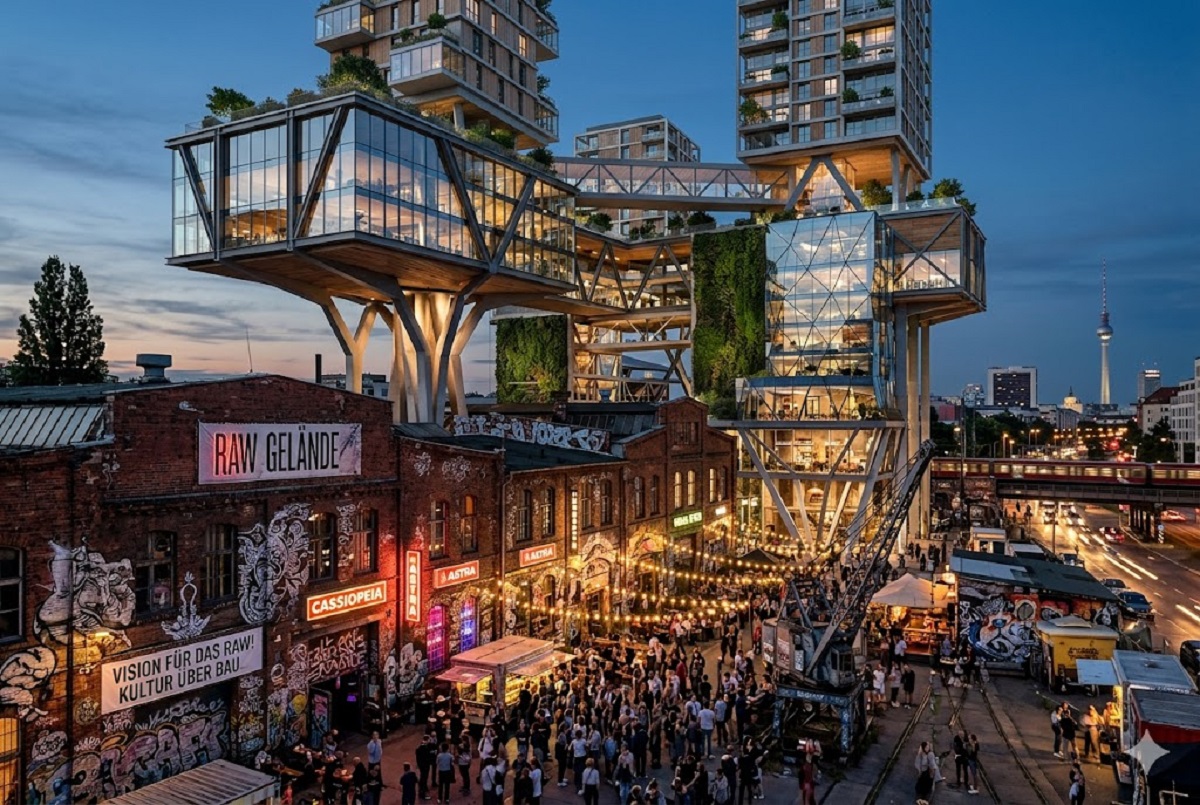
When you look at what is currently happening at the RAW compound in Friedrichshain, you just want to scream. The discussion is so bogged down in bureaucratic nitpicking, fire safety threats, and the eternal „investor vs. scene“ battle, that everyone completely forgets what this is really about: damn missed opportunities.
We in Berlin (and in Germany in general) are stagnating in our urban development to such an extent that it hurts. We talk about renovation, square meters, and the next development plan, while having long since lost touch with anything that is architecturally bold.
We Germans love to pat ourselves on the back because we invented the Bauhaus and consider ourselves a great industrial nation. But if you look at what is happening in our inner cities today, you have to be ashamed. We are floundering in such urban provincialism that it’s painful. We tear down, we concrete over, we build soulless, gray shoeboxes for start-ups that will be bankrupt in three years anyway. Nothing grand. Nothing to make us proud. Nothing anyone would pay an entrance fee to see in a hundred years.
While countries like the United Arab Emirates or Saudi Arabia (for all the justified political criticism) are architecturally reinventing the damn planet and laughing at the limits of gravity, we have been arguing in Friedrichshain for a decade about fire protection regulations and eaves heights. We have become a nation of naysayers and Excel slaves.
The RAW site is the absolute prime example of this misery. The investor Lauritz Kurth and local politicians are playing a tiresome game of Mikado: whoever moves first, loses. In the end, it will probably be bulldozed and a sterile business park erected, with about as much charm as a dental practice in Wuppertal.
But what if we allowed ourselves to dream? What if the people in charge of RAW saw not just the return on investment in the land register, but the potential of the place? What if architecture was once again understood as a work of art and not merely as space utilization?
Here is the “What If” check.
The Preservers: Where investors have understood the real value
There are examples out there where investors and urban planners have realized that you cannot erase what already exists, because this very lived culture is the only reason the neighborhood has any value in the first place.
The Gängeviertel, Hamburg: The ultimate proof that resistance works. A Dutch investor wanted to tear down the historic district and fill it with offices. But the urban society, artists, and celebrities kicked up such a massive fuss that the city of Hamburg caved, bought back the site, and handed it over to the creatives. Today, it is a pulsating center.
The NDSM Wharf, Amsterdam: A massive, dilapidated shipyard. Instead of flattening it, they left the giant halls standing. Artists built an absurd, three-dimensional village out of old shipping containers inside the hall. Today, it is Amsterdam’s absolute hotspot for festivals, studios, and yes, even start-ups. But it grew organically, rather than being forced down from above.
The Custard Factory, Birmingham: An old custard factory. A visionary developer didn’t sell the area to the nearest supermarket chain but transformed it into a massive creative quarter. Today, it is the heart of England’s digital and artistic scene.
Holzmarkt, Berlin: Actually, we can do it ourselves! The creators of Bar25 showed how it’s done. No luxury apartments on the Spree, but a completely wild, small-scale village consisting of culture, clubs, gastronomy, and a daycare center. It is proof that a cooperative can outsmart an investor (and a city) to create something truly for the people.
The Superstructure: When architecture suddenly gets brave
But it gets even wilder. If offices and commercial spaces are really needed so desperately on the RAW compound to finance the whole thing… why tear it down? Why not preserve the existing structures and simply build the new ones on top?
Here is where the wheat separates from the chaff.
Werksviertel-Mitte, Munich (The ultimate blueprint): When Munich (!) shows Berlin how to preserve subculture, we really ought to be collectively ashamed. On the old Pfanni site, the old potato silos and industrial halls were not demolished. The clubs, concert venues, and gritty corners remained intact on the ground level. And on top? They simply placed new, spectacular high-end architecture. Today, there’s a sheep pasture on the roof of „Werk3,“ while the bass booms down below. It’s an absurd, brilliant mix. The neighborhood is now the most expensive and fascinating in Munich. Old and new were not played off against each other but stacked on top of each other.
The St. Pauli Bunker, Hamburg: Take a massive, ugly Nazi flak tower that can’t be blown up anyway, and make it the foundation for something new. Overbuild it with a hotel, an event hall, and a lush mountain path wrapping around the concrete block. The monstrous existing structure is used as an anchor for a billion-dollar idea.
The Hearst Tower, New York: A radical middle finger to the classic „either-or“ debate. Norman Foster faced a low, historic brick building. Instead of tearing it down, he left the old shell completely intact on the ground floor, drove a massive steel skeleton into it, and simply pulled a hyper-modern skyscraper straight up through the middle of the old building. A perfect, brute-force symbiosis of history and future.
And what do we do? Imagine if we treated RAW exactly like the Hearst Tower or the Werksviertel. We would leave Cassiopeia, Astra, Suicide, and Urban Spree in their gritty, perfect brick caves exactly as they are. We would stretch a massive, architecturally brilliant structure over them. Floating glass cubes, gigantic steel beams, a vertical city rising from the old industrial ground without crushing the life below.
But that would require visionaries. It would require architects capable of more than just external thermal insulation composite systems. It would require politicians who say, „If you want to build here, then build us a damn world wonder and not just another run-of-the-mill shithouse for consultants.“
We have forgotten how to dream. We allow our neighborhoods to be increasingly hollowed out by investors who view culture as a mere cost factor. If RAW falls—and as mundanely as it currently seems—we won’t just lose a bunch of great cultural venues. We will finally be surrendering to our own lack of courage.
We define ourselves as an industrial nation, but in terms of urban planning, we have become a country of administrators. We no longer have architecture to be proud of because we only think in terms of „avoidance.“ We avoid noise, we avoid conflict, we avoid risk. And in the end, we avoid progress.
The Bitter Truth About RAW
Investors must finally realize: If you tear down RAW or renovate it to death, you will create a faceless glass wasteland that everyone will hate in ten years. Build over what exists! Use the substance as a foundation! Turn RAW into a beacon showing that Berlin still has what it takes.
But this requires visions that go beyond the next quarterly report. We need investors who see themselves as city builders and not as liquidators. And we need politicians who don’t take cover at every loud noise, but have the courage to allow greatness.
RAW is our chance to prove that Berlin is not finished yet. But if we continue as before with our provincial narrow-mindedness, Berlin will soon be nothing more than an open-air museum for what was once called „culture“ here.
Let’s finally stop settling for the status quo. The world is building for the future. We are only building vacant office blocks.


 and then