

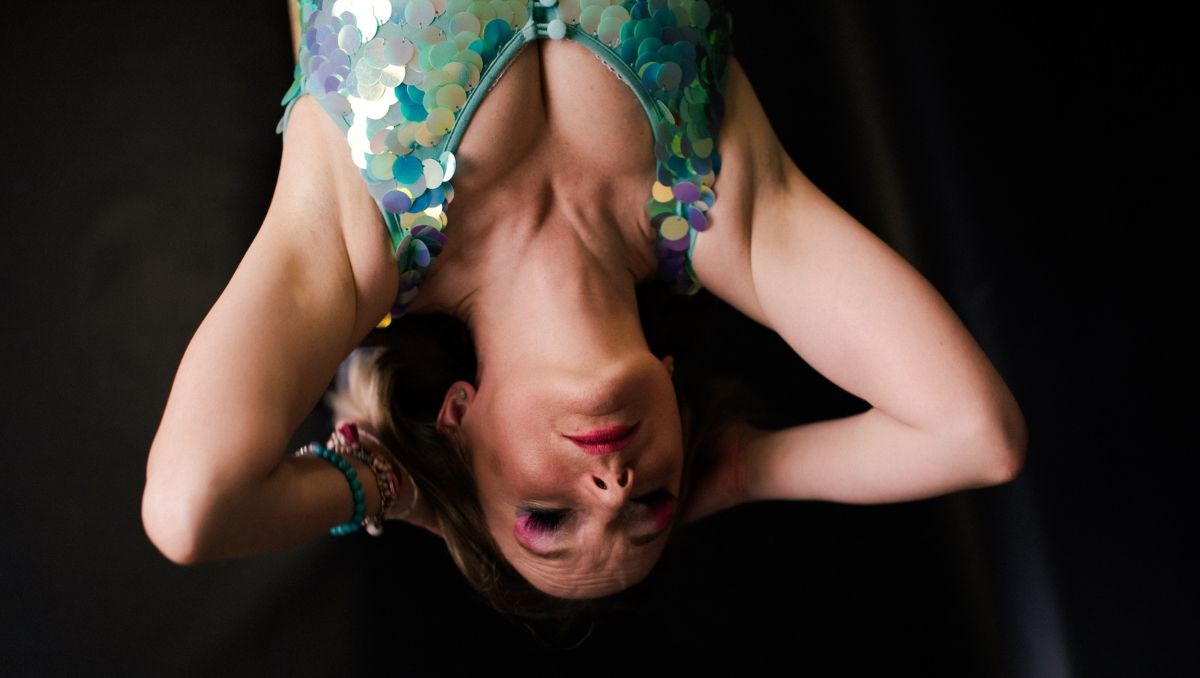
Few vocalists move as comfortably between club culture, live performance and songwriting as Cheryl Holland. On Deep Blue, her collaboration with producer Riigs, she brings those worlds together across a collection of liquid drum & bass cuts that balance dancefloor energy with deeply personal themes of grief, longing and resilience. Written during a period of profound personal loss, the EP captures an artist following instinct rather than formula, allowing emotion to shape every melody and lyric.
We caught up with Cheryl to discuss the making of Deep Blue, collaboration, sobriety, club culture and why space can be just as powerful as sound.
Although Deep Blue sits firmly in the drum & bass world, your background spans house, pop and classic dance music. What was it about this project that made drum & bass feel like the right vehicle for these songs?
Riigs first approached me with Catharsis and I really liked the vibe of it – how the track developed and flowed. The lyrics, melody and theme came together quite naturally and I knew we had a banger. I think that was the tester for me. He then gave me the next tracks, Chaser and Cerulean (which would become Deep Blue). I loved the drops, the synths, the bass and the depth of Deep Blue, and to me Chaser was just so sensual that it made complete sense to write something quite sexy. I think I wrote the majority of Chaser in about 20 minutes.
This was written at quite an emotional time as my mother was dying and then passed away, so I threw myself into the writing process. I also lost my voice through grief halfway through, so we had to pause and wait until it returned. But because of that, relationships with people like Lucinda, my vocal coach, Riigs, and Alex, another producer I worked with who recorded the vocals for Deep Blue and Chaser, probably wouldn’t have developed in the same way.
The EP feels equally suited to solitary listening and the dancefloor. When you’re writing, are you thinking about the emotional experience first, or how a track might translate in a club?
Everything all at once. I’m looking at how the track hangs together – verse, chorus, pre-chorus, drop. I get the emotional feeling from the music and see what melody, lyric or vibe develops from there. I won’t ever force anything. It comes when it comes, and it can come from anywhere. Catharsis came from a little flip I did in the pre-chorus. I actually got stuck on Deep Blue, but the obvious was staring me in the face. Chaser just led itself from the first initial ad-libs.
Your vocals sit right at the centre of these productions, but there’s also a lot of restraint in the arrangements. How did you and Riigs decide when to leave space rather than constantly adding new ideas?
The whole concept is around space – giving people space, reciprocity, waiting. Waiting for love, waiting for self-esteem to recover. Allowing people to do what they want to do. We both agreed the tracks needed to be quite simple arrangement-wise for the vocals to shine through. We made some changes to the original arrangement of Deep Blue, shortening the bridge so the vocals could cut through and build into proper arms-in-the-air moments.
You’ve worn a lot of hats over the years as a singer, producer, DJ and live performer. Has taking on each of those roles changed the way you approach writing and recording music?
I’m a singer and live performer first and foremost. DJing and producing are relatively new hats I’ve tried on for size. DJing has definitely informed how I approach producing and writing in really simple ways.
Running Glimmer has given you a unique perspective on what people are looking for from nightlife today. Do you think club culture is becoming more emotionally driven and less centred around escapism than it once was?
That’s a difficult one because I think the scene was different then. Plus I’m sober. A lot of young people are choosing sobriety from substances, which was one part of the escapism and sheer hedonism of it all. Obviously people are still doing what they’re doing, but ultimately people are coming together for the shared love of the music and to dance to it. People have danced together as ritual for as long as records have existed, and it’s the ultimate way of losing yourself while finding yourself at the same time.
There are a lot of organisations that are against sober raving because they feel it could cause a relapse. However, a lot of people in the recovery community have said it has kept them going. Yes, when you’re sober you feel everything anyway, but that’s why people come out – to feel things, to experience emotions, to feel part of something, like they belong. I also think it’s still quite a political thing.
You’ve played everywhere from UK festivals to Ibiza while also building music that’s rooted in personal storytelling. Have those live experiences changed the kinds of songs you feel compelled to write?
I don’t know. I write whatever I’m feeling. I write quite intuitively and from the heart. I might stop myself if I feel like I’m having too much of a whinge or having a pop at something or someone and think, „Nah – people don’t need to know about this. Change your tune!“
Collaboration often asks artists to let go of complete creative control. What did working with Riigs teach you about your own instincts as a songwriter and producer?
I think Riigs and I were on the same wavelength with this project. Neither of us had to compromise. We were both like, „This is sooo good.“ I guess he reaffirmed that I should trust my instincts. I’ve been quite lucky with the people I’ve worked with so far.
Looking beyond Deep Blue, does this EP feel like the beginning of a longer exploration of drum & bass, or has it simply opened another door in an already broad musical journey?
Possibly. I think my voice lends itself to liquid D&B, so it would definitely be an avenue I’d be up for exploring.





 and then