

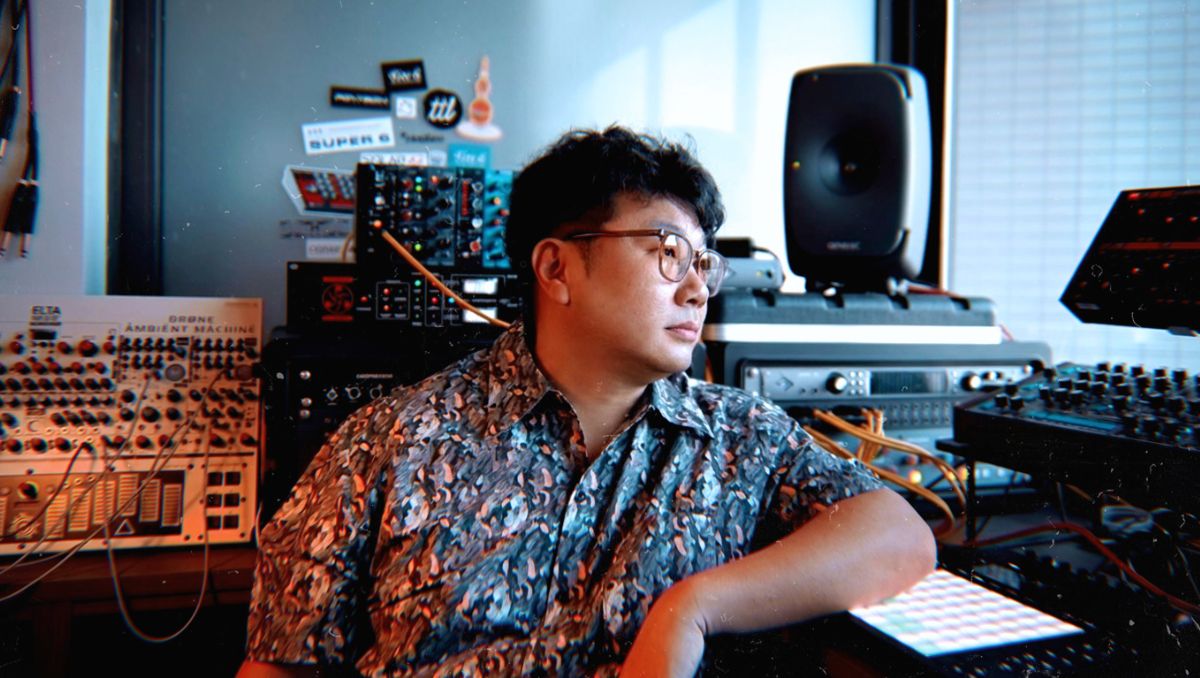
Indonesian electronic producer Wandour explores the relationship between sound, memory and place on his new album Echoterrium, released via Resilen Records on 28 October. Built around field recordings collected during his travels, vintage cassette loops and live instrumentation, the record moves between hazy ambient textures, downtempo electronics and more rhythmic, breakbeat-driven passages.
Ahead of its release, we caught up with him to discuss recording blizzards in northern China, his weakness for vintage tapes, bringing orchestral strings into the studio and the challenges of performing with cassette decks.
Where did Echoterrium actually begin? Was there a moment when you realised you had enough ideas and recordings to make an album, or had you been working towards something like this for a while?
The idea started taking shape after I made my first EP, Apriori back in 2019. With tracks like “September in London,” I was already trying to recreate the feeling of being in a particular place at a particular time. The title itself already gives you a fairly clear picture of what I had in mind. Its an early blueprint of Echoterrium
So for Echoterrium, I wanted extend that blueprint. Naming a specific place or season can guide the listener quite strongly, but I did not want every track to be tied so closely to my own experience. I wanted someone to hear the music and connect it to a completely different place or moment in their life.
So it was not really a case of realising I had enough materials for an album. I had started to lay the foundation around 2020. The album developed gradually, then became much more focused through the travelling and recording I did toward the end of 2025. In early 2026, I spent time in the studio bringing everything together and polishing it into a finished record.
You’ve collected sounds from all over the world. What’s the strangest thing you’ve recorded, and has anything that seemed completely unremarkable at the time ended up becoming an important part of a track?
One of the more unusual experiences was trying to record a blizzard for a track that did not make the final album. I wanted to capture its power, so I went to northern China in December, where the temperature was around minus 30 degrees Celsius.
The cold stopped the cassette mechanism from working properly, so I had to switch to a digital recorder. I was standing outside with this freezing wind blowing against me, trying to capture something that felt as intense as the experience itself.
The funny thing was that the recording sounded much less remarkable than I expected. When I listened back, it was difficult to distinguish it from a strong wind blowing by the sea. After all that effort, I had recorded another variation of howling wind, far from sheer power of a blizzard.
That experience stayed with me, even though the track did not make the album. It reminded me that an extraordinary experience does not automatically give you an extraordinary recording. Sometimes the feeling comes from everything happening around the sound, not just what the microphone captures.
How much of your music is planned before you start, and how much comes from messing around with equipment until something interesting happens?
The concept is usually planned, but how I get there is much more open. I might know that I want a track to bring back the feeling of rain or being beside the sea. I start with the field recording because that gives me a setting and something to respond to.
Then the fun, messing around part begins. I go through old jazz or classical cassettes, looking for a phrase or texture that feels right against that atmosphere. Sometimes I find a loop that immediately suggests a direction. Other times, I chop it up with a hardware sampler or put it through a granular processor until it becomes something quite different.
One of my favourite tools for that is a granular processor like evil pet, microcosm or tastychips. I like using equipment that can take a familiar sound somewhere I did not expect. So the emotional starting point is fairly clear, but I leave plenty of room for the sound itself to change my plans.
Are you a natural hoarder? I imagine that working with old tapes, recordings and fragments of sound means you’ve accumulated quite a collection over the years.
I would call myself a recovering hoarder. I used to collect so much equipment: synths, tape machines and all kinds of outboard gear. Eventually, I ran out of space, which was a fairly practical sign that I needed to stop.
I am trying to be more selective now and spend more time with what I already own. There is always another interesting machine out there, but buying it does not necessarily mean I will make better music.
The one thing I still find hard to resist is unused vintage blank tape, especially stock from the 1960s and 1970s. Those tapes are no longer being made, so finding them feels a little different from buying another piece of equipment. That is the excuse I give myself, anyway.
There’s a fair bit going on musically across the album, from breakbeats and deep bass to ambient passages and strings. What were you listening to while making it? Anything that might surprise people?
I was listening to quite a wide range of music. There was a lot of Johann Strauss and the London Light Orchestra, alongside early downtempo acts like Trüby Trio, Fragile State and Thievery Corporation. Then there were some of my favourite electronic acts, especially Underworld and the Chemical Brothers.
What might be less obvious is how much I also listen to bands like the Cure, Blur and Nirvana. I take inspiration from their beats and rhythms, even if the finished tracks do not sound much like those bands.
Tell us about Forest Spirits. How did you end up bringing a full string ensemble into the track, and was it difficult getting those orchestral elements to sit alongside the electronics?
“Forest Spirits” started with an ambient recording I made in Ashikawa forest in northern Japan. I wanted an ambient strings sound to bring out a mysterious feeling in that setting, so I began searching through my cassette collection.
I found an interesting string melody on an old tape I had bought in a thrift store in Osaka. I think it was a Japanese orchestra performing their version of “The Blue Danube.” That became the foundation of the track, but the way I sampled and looped it made it quite choppy. I liked that quality, although I was still missing the fuller orchestral movement I had in mind. Bringing in a real string ensemble gave me something to contrast with the loop.
Getting the two to sit together took some work. The clean, high-fidelity string recording felt separate from the worn textures elsewhere in the track, so I used an additional microphone setup to record directly onto cassette. That gave me a rougher version I could blend with the cleaner recording.
The tape added grain and softened the edges, helping the ensemble sit alongside the rest of the track elements. I wanted to keep the small, unpredictable details of musicians playing together while making them feel part of the same world as the rest of the track.
Do you ever find yourself ruining a perfectly good recording by spending too long working on it? How do you recognise when something’s finished?
Yes, definitely. I have learned quite a lot by taking things too far. Earlier in my production journey, I tended to send every sound through the same chain of equipment: EQ, compression, then perhaps another EQ and another compressor. I thought each stage was improving it.
What I eventually realised was that a sound could seem interesting on its own but become too much when combined with everything else. If every element had that much saturation and character, the mix became crowded and tiring.
Now I try to listen more and do less. The clearest sign that a track is finished is when I stop searching for mistakes and start enjoying it as music. If I can listen without constantly thinking about what needs changing, I know I am close. At that point, I try not to keep working just because I can.
Does nostalgia ever get in the way of making new music? I wonder whether there’s a danger of becoming too attached to certain sounds, equipment or ways of working.
I think it can, if you start treating a particular method as the only way you are allowed to make music. I try not to tie myself to the same process every time.
For Echoterrium, cassette recording made sense because of what I wanted to explore. The haze, wear and instability of tape fitted the idea of echoes and memories that are not completely clear. I was using those qualities because they served the album, not simply because I prefer everything old.
The next record might need a different approach. If the concept takes me somewhere else, I would be happy to change the equipment or the way I work. I want the idea to lead the process, rather than letting the equipment decide what every album should sound like.
How do you feel about playing this material live? Is Echoterrium something you’d want to recreate faithfully, or would you rather pull the tracks apart and see where they go?
That’s a good question and I’m still figuring out the answers. In the YouTube videos for some of the early singles, including “Seaside Moments” and “Echoes of Rainfall,” you can see me experimenting with playing different parts from cassettes on separate tape decks. It is almost like DJing with a collection of tapes.
I enjoy the physical side of it, but keeping everything together is difficult. You cannot cue a cassette as easily as a vinyl record, and each tape and deck behaves slightly differently. The speeds drift, so getting the parts to line up consistently can be a challenge.
Those problems are interesting creatively, but I am still working out how to turn the process into a live performance that feels good rather than spending the whole set trying to keep things in time. I may end up pulling the tracks apart and giving them more freedom. I like the idea that a live version could become another interpretation of the album, rather than an exact copy of the recordings.
Echoterrium is out 28 October on Resilen Records




 and then
