

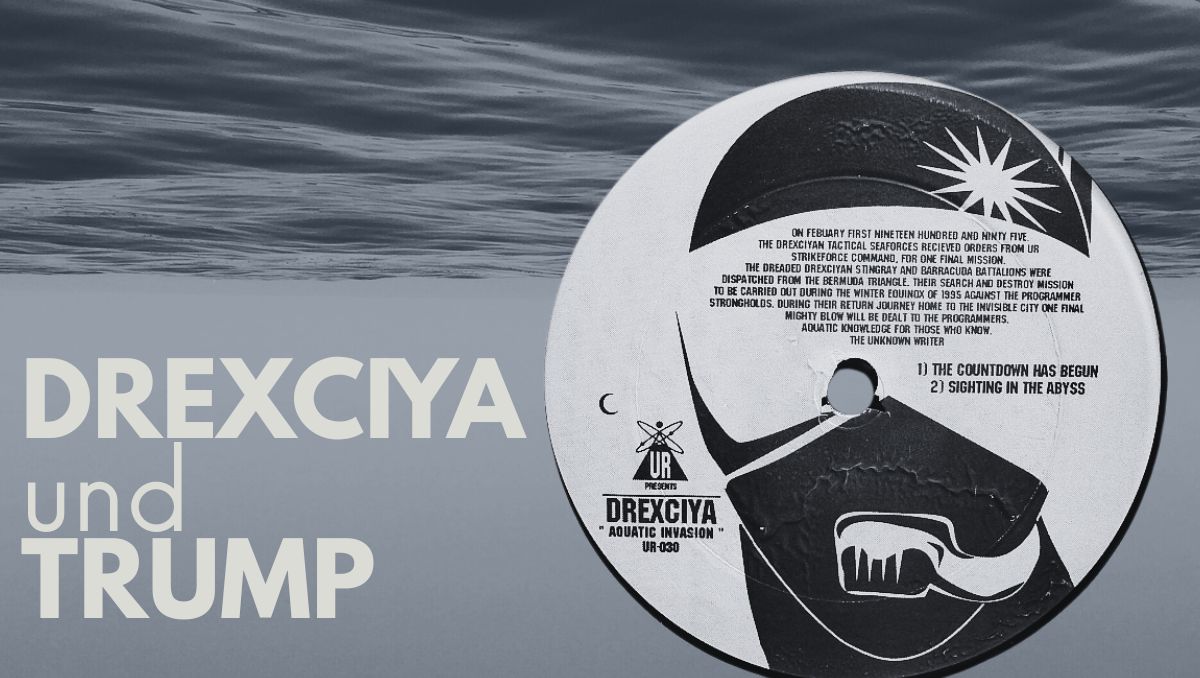
An exhibition at the Smithsonian National Museum of African Art in Washington, which dealt with the mythology of the Detroit techno duo Drexciya, triggered a response from Donald Trump. From the Deep: In the Wake of Drexciya by Ayana V. Jackson crafted an Afrofuturist scenario in which descendants of Africans lost during the Middle Passage form their own underwater civilization. It was an artistic attempt to reimagine trauma, survival, and the future.
The White House labeled the exhibition as „anti-American propaganda.“ In the logic of the culture war, it is not the artwork that matters, but the deviation from the desired national self-image that is seen as a provocation. When African American narratives claim not only victimhood but also utopian spaces, it becomes a threat to the idea of a homogeneous nation.
A parallel can be drawn in Germany. Recall the term “Leitkultur” (leading culture) from the late 1990s, originating from CDU circles as a conservative integration and values program. The AfD didn’t invent this rhetoric, but they have radicalized it sharply. Their demands go much further: they want theater and opera to become more „German,“ with classical German music and folk songs taking center stage, while migrant, queer, or postcolonial projects are pushed out of funding.
The pattern remains the same. Culture is not understood as a plural space but as a bastion of national identity. Everything that does not affirm this is marked as „anti-American“ or „un-German.“ The goal is a monolithic narrative that heroizes history and reduces the present to tradition.
The result: cultural politics degenerates into ideological discipline. Trump uses the term „anti-American,“ the AfD speaks of „national culture,“ and both mean the same thing. They want to make marginalized voices invisible, those that present alternative histories and futures.
The conflict around the Drexciya exhibition shows how quickly Afrofuturism can be politicized. In Germany, a similar dynamic threatens if cultural funding were to be restructured according to AfD guidelines. What remains, when only affirming art is left, is not culture, but a decorated textbook of national self-assurance.
Drexciya… Who?
In the underground of Detroit, a musical project emerged in the early 1990s that still stands out today for its radical consistency. Drexciya, consisting of James Stinson and Gerald Donald, released electro tracks that were as uncompromising as they were mysterious. But more than the beats and machines, it was the narrative hidden in the liner notes, track titles, and scattered fragments that defined the Drexciyan universe.
The story begins in the Atlantic. During the Middle Passage, countless enslaved Africans were thrown overboard. In Drexciya’s mythology, their unborn children developed the ability to breathe underwater. They survived, founded cities, and built a civilization. It’s a radical reversal: out of absolute trauma comes a utopia. Not a remembrance of violence, but a transformation into strength.
This myth is more than a narrative ornament. It lies at the heart of an Afrofuturist practice that does not leave African American history in defeat but extends it into a speculative future. While Sun Ra steered his spaceship toward Saturn, Drexciya turned its gaze to the oceans. Both strategies share an attempt to break out of colonial narratives and create new spaces of self-empowerment.
Musically, Drexciya blended raw drum machines with sonic science fiction. But anyone who understood the music as just a futuristic soundtrack missed the coded agenda. Track titles like Wavejumper, Aquatic Invasion, and Andreaen Sand Dunes read like coordinates on a map. The releases came as Mission Reports, equipped with cryptic texts reminiscent of scientific protocols. Drexciya was not just a duo, but a world.
Politically, this world-building shattered several frameworks. First, it shifted the view of the history of slavery. The Middle Passage was not only a place of death but also the birth of a new civilization. Second, Drexciya deliberately evaded commercialization. No promotional photos, few interviews, no compromises with the music industry. What was visible was not the person but the narrative. Third, Drexciya created a form of resistance that did not rely on direct slogans. It worked through encryption, allusion, and sound.
James Stinson once said that he did not come from Detroit, but from Drexciya. This statement embodies a radical understanding of art: it is not an image of reality, but an alternative reality. That this reality embraces black history and transforms it into utopia is its political core. In Paul Gilroy’s Black Atlantic theory, Drexciya finds a theoretical echo. The ocean here is not just a trade route and a grave, but a space for new identities.
After Stinson’s death in 2002, the legend persisted. Gerald Donald continued the work in other projects, labels like Clone kept the archive alive. Drexciya has since become part of the art world, from essays to exhibitions like Ayana V. Jackson’s From the Deep: In the Wake of Drexciya at the Smithsonian. The transition of subculture into the museum context shows how far-reaching this mythology has become. It functions as an aesthetic, political, and spiritual reference.
Yet the relevance goes deeper. In an era where right-wing movements are once again invoking national culture, Drexciya stands as an open challenge. The deep sea as a place of resistance that remains invisible and eludes control. An imaginary space where survival is not only possible but the foundation of a new future.
Drexciya was and remains an alternative to all attempts to reduce culture to national identity. Instead, this project shows how history can be told differently when viewed from the perspective of the marginalized. From the deepest abyss of violence emerges a myth that endures—not as a story of victimhood but as a self-contained universe.






 and then