

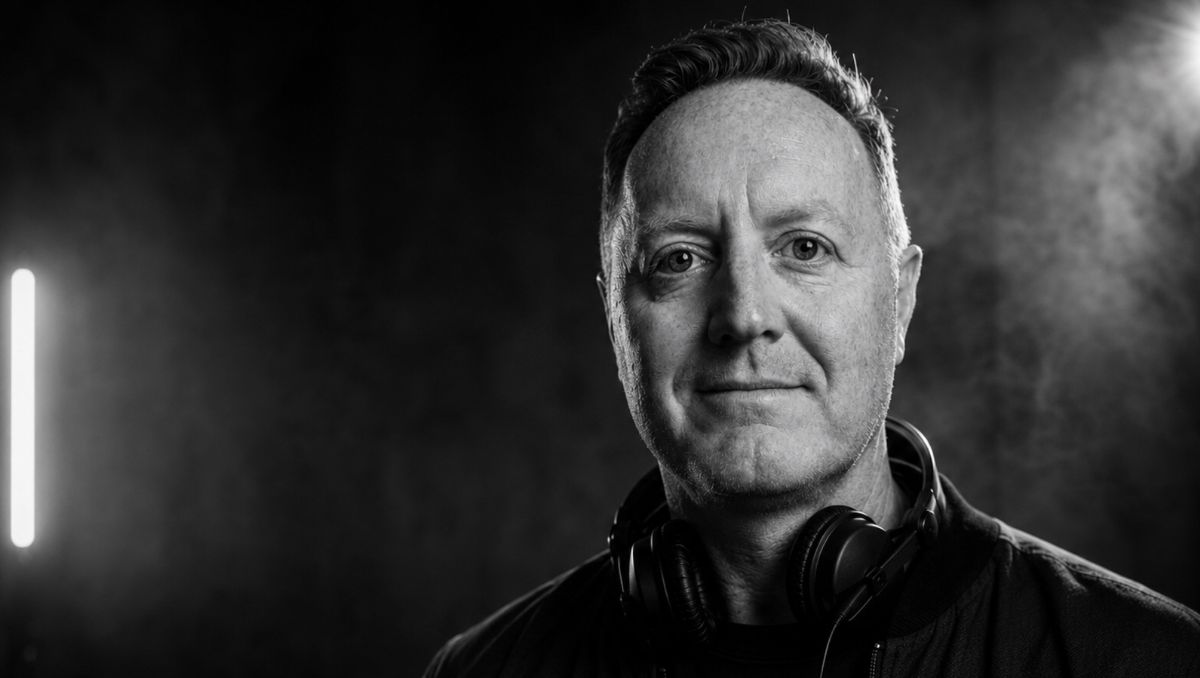
MF Quinn’s recent run of releases is beginning to reveal the shape of an artist hitting his stride. With music landing across Play Records, World of Sound, NOXU Deep, WH Records and Toolroom Trax, the US producer has sharpened a house sound built around disco and funk influences, lean arrangements and memorable vocal hooks. We caught up with Quinn to discuss finding consistency without forcing creativity, what he has learned from the producers who shaped him, the value of outside recognition and why this latest chapter feels like the beginning of a broader body of work.
You’ve said that your strongest ideas often emerge when you stop actively searching for them. With a much fuller release schedule now taking shape, how do you protect that instinctive way of working from the pressure to produce music consistently?
I’ve found that deadlines can actually create a more focused kind of creativity, especially when I break a project into small goals. When I step away from the studio, I take mental notes, then write down the important ones so I know where to pick things up next time. It might be the type of kick I want to try, a different delay on the vocal or a small arrangement change. When I come back, I have a clear plan I can put into action, and that usually gets me into the flow pretty quickly. It helps me meet deadlines without feeling like I have to force an entire record into existence on demand. I can stay consistent about the process while still leaving room for the instinctive ideas to show up.
Your recent records are appearing across Play Records, World of Sound, NOXU Deep, WH Records and Toolroom Trax. What connects that run of releases for you, and what does each label reveal about a slightly different part of your sound?
The main connection is the disco and funk influence running through this group of records, along with a more consistent approach to arrangement and mixing. I’ve been applying the workflow I’ve developed, but the results change depending on the references I’ve been digging into, the bassline I come up with or a sample that catches my ear. Each label selected a slightly different shade of that sound. Play Records brings out the classic, club night house side; World of Sound and WH Records reflects the more direct, energetic side; NOXU Deep connects with the rawer, original eras of House msuic; and Toolroom Trax puts the focus on precision and peak-time impact. I didn’t set out to create five different versions of my sound. Each label simply heard the part of it that fit naturally with what they do.
The Bad Side EP introduced a sound rooted in classic house and tech house, while the newer material feels increasingly lean, controlled and built around fewer elements. Has learning what to leave out become as important as deciding what to add?
Yeah, learning what to leave out has become even more important lately. A lot of that has come from diving deeper into mixing, because mixing forces you to consider how every element works or, more importantly, doesn’t work with everything else. Earlier on, if a section felt unfinished, my instinct might have been to add another sound. Now I’m more likely to create space, improve the movement or strengthen what is already there. A lot of great music is simple at its core. A four piece band can fill a stadium when the songs, sound and delivery are strong, and I think the same principle applies to house music. Restraint isn’t about making a track feel empty; it’s about making sure the parts that remain are doing something meaningful.
Vocals have become a central part of your records, but you tend to use them as rhythmic and emotional hooks rather than conventional toplines. What are you listening for when deciding whether a vocal has enough character to carry a track?
When I’m deciding on a vocal, I keep asking one question: what is the motif? When the record ends or the next tune comes on, is the listener likely to remember that phrase? On my official remix of ‘Inner Mind’ by Smokin Jo and D.Ramirez, for example, there were a lot of great vocal lines in the original, but I chose one motif and repeated it throughout the track. That gave the record an identity without asking the vocal to tell the whole story. I’m usually listening for rhythm and phrasing as much as meaning or the pauses, the emphasis and the way the words sit against the groove. Because the track is built first for the dance floor, the vocal needs to register quickly without taking over. A short phrase with real character can be much more powerful than a full topline.
Your Magnetic mix from last year placed your own music alongside Todd Edwards, Dennis Ferrer, David Morales, Mark Knight and Armand Van Helden. What do those producers understand about making functional club music that still carries personality and emotional weight?
I think they understand that moments matter, and that craft still cuts through even in a saturated market. Their records work in a club because the fundamentals are right, but they also create specific moments that stay with you. Mark Knight’s tracks, for example, can feel like riding a simple but elegantly crafted roller coaster. The arrangement takes you on a journey, builds anticipation and delivers the release at exactly the right time. They also have recognizable musical languages, whether it’s Todd Edwards’ rhythm, Dennis Ferrer’s emotional weight, David Morales’ musicality or Armand Van Helden’s personality. None of it feels anonymous. That’s the lesson for me: make the record functional, but give people a moment and a point of view they can remember.
The move from self-releasing your debut EP to working with several established labels has happened relatively quickly. Has outside recognition changed your confidence in the studio, or are you still questioning records as much as you did at the beginning?
Yeah, it’s been a huge confidence boost. I question myself less and get more excited to show people what I’ve been working on, whether that’s in a feedback session with other producers or when I’m sending out demos. At the beginning, I was returning to music production after a long hiatus and trying to absorb as much as possible and how to make music with a clear direction, how to finish records and how to do it consistently. The mentorship I’ve received through Toolroom Academy has been a major part of that. It gave me a stronger framework for learning from feedback, developing a repeatable process and understanding that consistency as an artist is about more than releasing often. Having established labels respond to the music tells me that the work is connecting outside my own studio. I still question the details, but it’s a healthier kind of questioning now. Instead of wondering whether I belong, I’m asking whether the groove, arrangement and mix are as strong as they can be.
You’ve previously spoken about recognition meaning more when you are operating independently. As the project grows, how do you distinguish between useful validation and the kind of external noise that can pull an artist away from their original instincts?
I’ve come to see making art and sharing it with the world as a way of saying, ‘I was here, and this is how I saw things.’ For me, validation completes that exchange. First, making something I believe in; then knowing it reached someone else. That might mean one listener telling me a track connected with them or hearing that an established DJ played it on their radio show. It’s like a virtual fist bump across the universe. That kind of recognition feels useful because it comes back to a real connection. The noise is everything that makes me compare my pace or my numbers with somebody else’s. I can look at those things as information, but I don’t want them deciding what I make. If the response brings me closer to the reason I started, it’s useful. If it pulls me away from my instincts, it’s noise.
This summer’s schedule could easily be presented as a sequence of separate label milestones, but does it feel more significant to you as evidence that a broader MF Quinn identity is beginning to take shape?
For sure. I’ve been focused on developing a consistent sound and, through that process, finding my identity as an artist. All the tracks in this run have similarities: the disco and funk influence, strong low end movement, memorable vocal motifs and a fairly lean approach to arrangement, but they also stand on their own. That balance is important to me. I don’t want every release to sound like a copy of the one before it, but I do want there to be a recognizable MF Quinn thread running through them. The label milestones are exciting, but the bigger achievement is seeing the records add up to something coherent. It feels less like a collection of separate releases now and more like the outline of a broader body of work.
Once the current run through Play Records, World of Sound, NOXU Deep, WH Records and Toolroom Trax is complete, what is the next step? Are you looking to deepen relationships with those labels, widen the musical scope of the project, or begin working towards something more substantial than individual club releases?
I actually have a couple more records in the queue for later in 2026, and after that the goal is to keep building with the same consistency in the studio and with releases. Once I found my lane, making music became even more fun because I could execute ideas with more confidence while still finding new ways to move within that sound. I have ideas I’m really excited about, a few possible collaborations in the works and projects for 2027 already taking shape. My monthly Data Transmission show, MQ Sessions, is another important part of that next step. I love crafting mixes that align with my own sound and direction, and the show gives me another way to share the wider musical world around the records.





 and then