

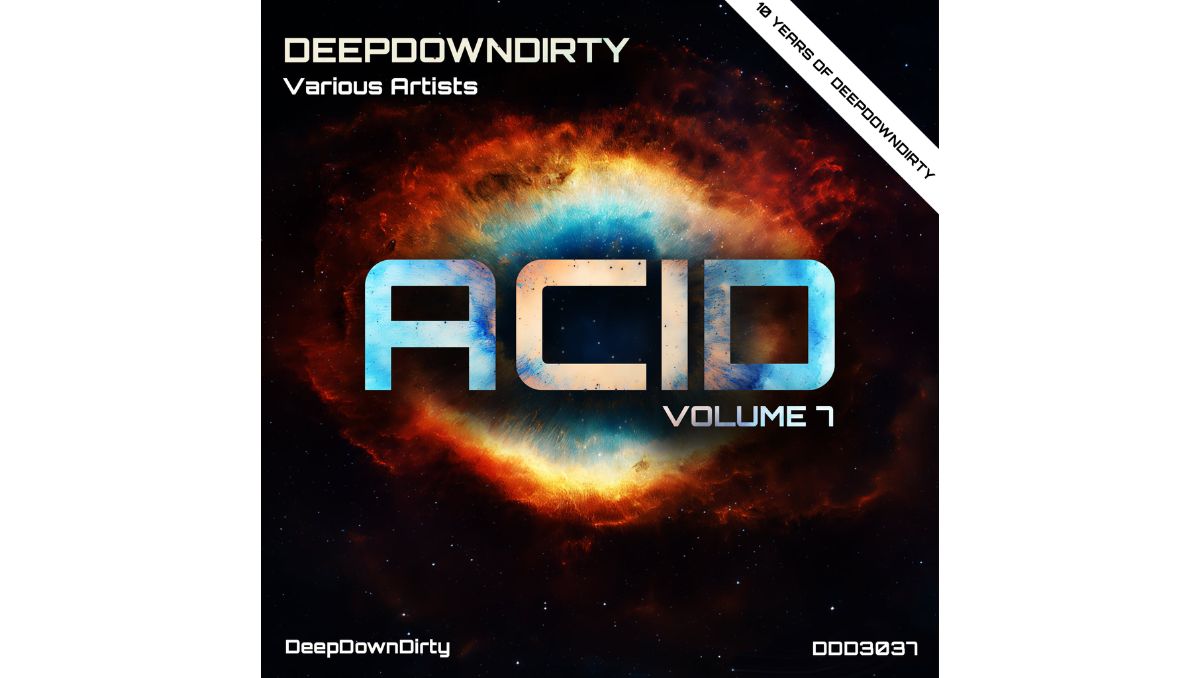
DeepDownDirty is hitting ten years. What’s the first moment you realised “oh… this is becoming a real thing”?
I think there were a few moments.
When our friend D-Vox dedicated a whole radio show to the record label and we livestreamed it. The support was incredible.
When Paul Sawyer of Krafted decided to get involved in our charity release Fall On Me for the Last Night A DJ Saved My Life Foundation, and he and his label partners over at Krafted interviewed me about the release, tagging the interview onto one with Quivver. The interview got a lot of views. Great PR.
When Phil Hartnoll of Orbital agreed to do a remix for us, then asked me to send him a DeepDownDirty T-shirt and sent me an awesome photo of him wearing it. Electronic music PR gold.
What was the original mission when you started, and what’s the mission now after a decade of releases and community building?
To not be an a-hole, to promote creativity and connection. This remains the same. I try to help the producers I work with, finding them colleagues and even other labels to work with. I try to make DeepDownDirty not about me, but all about community and helping creatives. We had two straplines at the beginning: #NotAboutTheGenre and #MoreMusicLessEgo.
If you had to describe the label’s “taste” without naming genres, what would you say it’s drawn to?
We are multi-genre, so it’s less about taste than about what I look for in a track: good structure, a good hook, and preferably some kind of vocal element. I will admit, however, that I am a sucker for a 303, a sub, and a lover of breakbeat.
What’s one lesson you learned the hard way about running a label that you wish you’d known in year one?
Don’t ever let people providing remixes for the same release handle their own mastering.
Community, culture, and what makes it DeepDownDirty
The label has that “friendly community” vibe. How did you cultivate that, and how do you protect it as things grow?
Ah, this sounds a bit trite, but a few people have called me their “Music Mum” over the years. I just try to be kind and nurturing, helpful, understanding and supportive. And be honest. When I fuck up, I ’fess up and try to fix it ASAP.
The only way to protect it is not to work with people who have no respect for their fellow humans.
What does “DeepDownDirty” mean to you now, beyond the name? Is it a sound, a mindset, a standard, a party, a family?
DeepDownDirty was a name I originally chose with deep and dirty beats in mind and, yes, of course, because it sounded a little sexy and fun. Now, we are a community and many of the producers have become friends. I feel very blessed.
What’s the balance between chaos and curation for you? How do you keep it wild without losing the thread?
I am ashamed to say I have absolutely no idea. Still just winging it. But now I say no more often to tracks. If it doesn’t stir emotion in me, excitement for some reason, it’s a no. But anything else goes.
The Acid series
Acid Vol 7 is described as a bumper, multi-genre “monster” of a compilation. Why does acid still feel so limitless as a sound in 2026?
I really don’t know. All I remember is when I first heard it as a kid and how much it excited me. It still does that to me, and it must stir that in a lot of other people.
When you’re sequencing a huge VA like this, what are you prioritising: flow, variety, surprise, DJ utility, narrative… or “all of the above but squelchier”?
Flow, and sometimes a narrative. I really enjoy the process.
The release blurb hints at producers working outside their usual genre, and track titles reflecting real life. Do you encourage that kind of left turn, or does it just happen naturally in the DeepDownDirty orbit?
People release with me because they know I am open-minded. It is just an understanding between them and me: be what you want, create what you want, have fun. I used to say this in the early days, but most people know now. Maybe I need to remind them and tell them again.
“If this sounded like anyone else’s release I would not be doing my job.” What are your non-negotiables when it comes to originality?
I’m not so hard-nosed. It’s not my character. Sometimes people send me tracks and I make suggestions because my brain hears additions that I feel strongly about. It’s all about discussion and learning together.
Process, tools, and the craft
Are there any recurring production signatures you secretly love hearing when demos land, like certain drum feels, 303 attitude, or arrangement choices?
I am a real sucker for a breakdown in a different genre than the main track, to be honest.
How do you typically A&R a track for a VA: do you hear it as a standalone weapon, or as a chapter in a bigger story?
Both.
What’s your approach to cohesion across such a varied multi-genre set? How do you make it feel like one album without sanding off the edges?
I think that’s where the track placement and PR comes in.
Looking forward
After Vol 7 and the 10-year milestone, what excites you most about the next phase of DeepDownDirty?
Well, it’s been very organic until now and I plan on keeping it so, so who knows what the future holds? Every year has been exciting. More interesting things will happen, I am sure.
If someone is discovering the label through Acid Vol 7 on February 27, 2026, what do you hope they feel after the last track fades?
That we don’t just put out DJ fodder.
Artist Roundtable – Digging a little deeper.
1. What’s your relationship with acid and the TB-303? First obsession, lifelong addiction, or recent rabbit hole?
Stephen Hardaker: Lifelong addiction.
Alex Ridley: It’s absolutely a lifelong obsession. When I was 15 years old I was dabbling with electronic music production and messing around with FL Studio and its 303-type emulator synth. I was attempting to make super spacey, bendy sounds and I just loved the sonic textures. Shortly after that I heard Richie Hawtin’s Plastikman work and it was like he was writing what I didn’t quite know I was trying to write yet. His work really resonated with me back then and still does now. Follow-up acid records always seem to hit a note with me. The dark, repetitive, hypnotic fluctuations created a psychedelic groove that I always thought should be synonymous with electronic music and warehouse parties. DJ Garth, ETI – Twenty Minutes of Disco Glory (Acid Rock Mix) really drives those vibes home and was also a huge anthem for my friend group years ago. We would play it over and over and over at afterparties, quite often just picking up the needle and starting the record over again.
D-Manic: I first came across the captivating sound of a 303 through my mother… yup, my heavy metal loving, classical loving, rock ’n’ roll loving mum. She fell in love with acid house in the 80s and would play these tracks at full volume whilst she did the housework. I fell in love with it too.
Minus RF Star: Love-hate. I spent years believing it was the most overrated synth of all time, then more years trying to recreate the feel using other gear before finally coming to the conclusion that it’s the most inspired little silver box ever created.
Max E Groove: I fell in love with the sound of acid in the mid to late 90s after going to Elevation at Shaftesburys and a little club in Soho called Gulliver’s.
Sword Swinging Robot: I’ve always loved the sound of the TB-303. It’s such a simple synth but so flexible and full of character. There’s an endless list of standout acid lines and the 303 always shines through regardless of the genre or how it’s processed in the mix. It’s also incredibly fun to play live, which is why I rarely leave home without my trusty Roland TB3.
Axel Doorman: As a kid, I was already obsessed with the squelching sound of the TB-303, but it actually took a while before I finally knew what it was. By the time Rebirth, that nifty little software pack by Propellerhead, came on the market, playing with a sort of 303 came within reach for the first time. I think that’s what really got me hooked. From there, it never left, and there are not many tracks I’ve done without it in one way or another.
Spliffy B: I got into acid and rave music when I was around 12 years old, around 1994. Outside of the music my dad played, the earliest music I connected with came from my brothers’ rave compilation tapes which covered techno, rave, hardcore and house. At primary school I barely heard any music as I didn’t pass a hearing test until I was 7 and then didn’t pass another one until I was 9, so when I did finally start hearing things properly, the wild, alien sound of a 303 absolutely grabbed me. I got my TB-303 around 2003. A friend at the time was clearing out his music studio and he had an original TB-303 and wanted it to go to a good home, and felt I was that good home. I still use it in my productions today alongside a few clones that are creeping more and more into my workflow.
Einar Heløy: My first step and touch into acid music was with Josh Wink’s Higher State of Consciousness. Also: It’s Our Future by Awex, Acid Phase by Emmanuel Top, The Ultimate Seduction by Meat Katie & Dylan Rhymes, 2 Men On A Trip by Lee Coombs & Meat Katie, The Chemical Brothers’ first album Exit Planet Dust, and Say Hello (Dylan Rhymes Acid Thunder Remix) by Deep Dish. My favourite acid tracks of my own creation are Castle in the Sky by Kenshi Kamaro, Halycon Micro Orbit by Kenshi Kamaro, and my bootleg Touch Me (Kenshi Kamaro’s Unofficial Remix) by Rui Da Silva feat. Cassandra.
Jacki-e: It’s quite a recent interest arising from a desire to incorporate sounds in my tracks that I don’t usually use. To me the acid sound created by the TB-303 is very visceral. It’s a sound that feels genuinely physical, not just musical. It doesn’t sit still, it pushes and pulls against the groove and in that sense it’s almost behavioural. Great techno is about tension and movement, not perfection, and with 303 acid sounds you never fully control it. You can try to steer it, you can react to it, but it’s almost as if it has a life of its own. I like the feel of controlled chaos within a techno track that might get out of hand at any moment, like an unruly adolescent.
Chris Prole: I’ve been into acid for most of my life, having older cousins who were into it from the late 80s when the acid craze took off, going to the legendary Sterns, the M25 circuit and warehouse raves. The track that really cemented my obsession was Bam Bam’s Where’s My Child. Moving away from the 303 throughout the 90s with jungle techno, DnB and even happy hardcore, I then went back to house throughout the 2000s. In 2014 I got back into acid as a producer, but by that time the original TB-303 was, and mostly still is, way out of my price range. I was using VST clones of the 303 which were great for what they were, but not quite hitting the spot with the lack of hands-on jamming functionality. So when Roland brought out the Aira TB-3, I jumped on it at a very affordable price. Then my love was fully reignited again and I ended up launching my Acid 606-61 label which focuses purely on 303 sounds: retro to future. Since then I’ve developed what the missus thinks is an unhealthy obsession in collecting 303 clones.
Filter Sequence: I first saw a Roland TB-303 thanks to my dad. It was probably 1981, not long after they came out. My dad took me to Macari’s guitar shop on Charing Cross Road in London. He was buying me my first ever pedal, a Colorsound phaser for my electric guitar, which was a black Les Paul copy. We were gazing at various items in a display cabinet and I remember my dad telling me that this silver box from Roland was to help guitarists practise along with a bass player if they didn’t actually know anybody who played bass. I then remember a year or two later hearing Rip It Up by Orange Juice. This had a squelchy sound to it which I had no idea what it was, but I liked it. A few years later I heard Phuture’s Acid Trax, but the track that really blew me away and got me hooked was Stakker Humanoid.
One Hat Man: I first heard Charles B & Adonis’s Lack Of Love and that still to this day has the best 303 bassline ever. It sounded so new, so alien, all that squelchy goodness. I thought then, I’ve got to get involved in making dance music.
Staple Hill: My relationship with acid was tingled by the sounds of Orbital’s Chime and Hardfloor’s remix of Yeke Yeke. For me it epitomises the electronic sounds I first heard, and yearned for, when I heard Popcorn by Hot Butter.
Sonic Construction: Lifelong, I’m afraid. 303 Anonymous here. Long before I knew what a 303 even was I was captivated by early acid sounds such as Stakker Humanoid and spent so much time trying to recreate acid-type sounds on hardware that definitely shouldn’t be able to create it, such as a Casio VZ10. I eventually made my own “acid synth” called the Freerez that could make fairly convincing sounds and used it in some of my early 90s compositions. Throughout my stuff there is usually some acid somewhere. It’s in my DNA, I guess.
Spryt Electra: I was a raver in the early 90s, loving the sound of the TB-303 on tracks like Adamski’s NRG and Stakker Humanoid by Humanoid, a project by Garry Cobain, half of Future Sound of London, who I later interviewed along with Sasha, Carl Cox, Laurent Garnier and many others for my video magazine The Edge. In the early 90s I produced iconic flyer artwork for the Eclipse, the first UK club licensed until 8am, still coveted by collectors today, and was one of the first VJs, doing visuals at raves for 8,000+ people.
Tim Techlor: When I first got into techno in the early 90s, the 303 sound was somehow always present. It was a wild time: techno was brand new and there was no internet, no Google, no streaming services, no platforms you could just visit to get info on tracks. Our “Shazam” back then consisted of somehow memorising that cracking track from the club, running to the record shop, and singing it to the guy behind the counter. Almost all my money went to our local record shop, which also stocked the more obscure stuff. In 1995 I bought one of my absolute all-time favourites there: Confusion by The Pump Panel. All four tracks on the single were absolute milestones for me. Long story short, I guess “lifelong addiction” is my answer.
2. Did you set out to write for this VA specifically, or did the track already exist and then found its home?
Stephen Hardaker: The track already existed before, but I asked Jess to add vocals specifically for the DDD album.
Alex Ridley: For Kyle (QUBE) and I, we’d been wanting to collaborate for a long time at that point. As the track was fleshing itself out, the DDD crew came to mind and I was nervous to pitch it for the acid release, as it’s something I’ve wanted to be a part of for a long time, but it worked out in the end and I’m grateful to have had the opportunity to work alongside QUBE for this and to get to be on the album.
D-Manic: I did. I’ve had the privilege of having my tracks on three, I think, DeepDownDirty Acid compilations now. I always start thinking about it in December lol.
Minus RF Star: It’s written specifically for the release, but there’s a story behind it. Most of last year my wife was being treated for breast cancer. By the middle of the year she’d lost most of her hair so she decided to knit herself a wig. In these circumstances you don’t want gloomy music, so although most acid is dark I wanted to write something happy and bouncy. I thought the idea of reacting to losing all your hair by knitting a wig was absolutely priceless, so I wanted music that would somehow reflect that. The title “Knitting” is about all of those things.
Max E Groove: This track was specifically saved for Maya & DDD. I made it a while back and played it in my DJ sets.
Sword Swinging Robot: My track was written for the album. It’s really inspiring to be part of this kind of album project and knowing that the track will be part of such a diverse collection really motivated me to bring my best and try to find a distinct sound.
Axel Doorman: I actually start on a few projects over the year specially for this compilation. I’ve been on a couple and for every new compilation I try a different kind of approach.
Spliffy B: One thing I love about DeepDownDirty is the freedom. I can explore genres I don’t always get to release elsewhere. Most people know me for my Stay Up Forever and Planet Techno material, but DDD lets me experiment with different vibes. This track actually existed before the VA. It was an acid-breaks piece with a proper oldskool feel, but I didn’t have a home for it yet. When the opportunity came up, DDD felt like the perfect fit. I’m honoured to be on another release with them. They’re one of the hardest-working, most supportive labels around, with an absolutely awesome label owner.
Einar Heløy: I made Bounce The Pink Acid just for DDD for the Acid Release Vol 7. It’s more a club track, an after-hours-style deep and dirty groove. I’m proud to know Maya for 100 years and more. It’s an honour to be on DDD. Maya supports me with kindness and honesty. The DDD Acid Compilation 7 is pure magic and I’m happy to be on it.
Jacki-e: I Want The Acid was written specifically for DDD Acid Vol 7. I wanted to write something that remained true to the spirit of acid, but within a modern techno framework whilst incorporating the unique features of my own sound. It’s not about nostalgia for 90s acid techno, it’s about the modern dancefloor and the peak-time techno drive and rhythm. Once I’d locked in the main groove I wanted the track to conjure in the listener that moment of joyous abandonment to the music.
Chris Prole: Yes, my track Broken is written exclusively for this VA comp. I’m not really producing much any more these days but it’s my yearly ritual to always make a track for the beautiful human Maya over at DDD.
Filter Sequence: Part of my live set contains a track called Acid Jubilee which I sing or speak some beat poetry ideas over. It seems to go down well at gigs and I wondered if I could do a part two to it. I thought of the name More Acid as it was an extension to Acid Jubilee and then amazingly I bumped into the brilliant Dave Letorey who is known for shouting out “More Acid” at the top of his voice at gigs by a certain electronic duo. It all came together quite quickly.
One Hat Man: The track Voyager is written specifically for DeepDownDirty. I find it easier to work to a brief. A target to achieve makes you focus.
Staple Hill: I’m always making music. Move already existed.
Sonic Construction: I wrote this for the lovely DDD fam as I wanted to share something new and also show a lot of love for the traditional squelch. As is often the case, stuff that is happening in my personal life ends up colouring a track.
Spryt Electra: I wrote I Feel You specifically for this compilation, originally as a DAW-less hardware jam for my YouTube channel, playing it at live gigs before adapting it for a full production.
Tim Techlor: I actually produced this track from scratch specifically for Acid Vol. 7.
3. The compilation jumps across breakbeat, DnB, tech house, peak-time techno and more. Did you lean into your usual lane or purposely do something different for Vol 7?
Stephen Hardaker: I tend not to deliberately focus on one specific genre, however this track seemed to naturally flow as an acid track.
Alex Ridley: While working with QUBE I had to learn how he operates and writes. He’s got a very different style from me and it brought out some new ideas and twists from my end. He’s very artistically minded and has always got ideas on the go. So having a constant flow of fresh ideas allowed us to bend from our norm a bit as a duo while still staying true to our own individual sounds.
D-Manic: Originally I was going to go down the dark techno route, but thought something with a bit more pace and drive would be something different. My good friend Tim (Micron) became a part of this track when I felt a collaboration would work better as I was in a bit of a creative black hole lol. His input and ideas helped kickstart the process again.
Minus RF Star: Very definitely outside of my comfort zone. I’m normally more on the breakbeat, DnB and ambient end of things. That’s another reason why I wanted to use a major key. If I tried to make a normal acid track I’d be shit at it.
Max E Groove: I submitted something from my usual genre. I like the combo of quotes, speeches and quirky lines in my tracks, as in Scent of Integrity. I think it helps to capture the energy and euphoria I like to create on the dancefloor.
Sword Swinging Robot: I went for a similar melodic techno style as my last DDD Acid track Flying Fish. I tend to follow wherever inspiration leads, so who knows what I’ll make next year.
Axel Doorman: Since I was born in the early 80s and grew up in the 90s in the Netherlands, I have been heavily influenced by the early gabber sound, but as time went by I started experimenting with more styles.
Spliffy B: I definitely did something different to my usual material. I’ve been wanting to make something more oldskool-breaks-focused for a while, and this was the perfect moment to do it. I’m genuinely grateful for the opportunity.
Einar Heløy: No answer provided.
Jacki-e: I remained true to my peak-time, driving techno sound and I used a 303 bassline, an acid rhythm and vocal samples. My tracks usually focus on energy, tension, build and then release. In I Want The Acid I let the 303 sounds become the engine room doing the heavy lifting and driving that process, and used the vocals to deliver a perception shift in the listener whereby they become lost in that moment on the dancefloor.
Chris Prole: I always find it a great pleasure to make tracks for these multi-genre comps because Maya allows freedom of expression, allowing me to break out of my usual styles which develops me further as a producer. Specifically with Broken, I’ve leaned into a more downtempo, wonky kind of flow.
Filter Sequence: I’d say about 80 percent of my tracks have a 303 in them. It’s got quite a retro feel to it I think, so is quite consistent with my interest in dance music from 88 to 92.
One Hat Man: I tend to create 4/4 acid tracks at a faster tempo than the older stuff from back in the day, with bits from other influences to keep it rolling.
Staple Hill: Ooh. I have no usual lane. I have phases. I’m going through a breaks and DnB phase at the moment.
Sonic Construction: I’ve always blurred the boundaries between different genres so when I start creating there is rarely a target style. The music usually takes me where it wants to go. This turned out as what I would call classic acid house with a firm squelchy nod back to the roots of 1986, and I managed to get in a good old 808 snare inspired by Somebody in the House Say Yeah by 2 In A Room.
Spryt Electra: Originally exploring “I see you”, “I hear you”, “I taste you”, the sensual sound of I Feel You became the heart of the track. Using my trademark vocoded vocals, analogue synths and drum machines with a hint of the 80s, combined with contemporary dance production.
Tim Techlor: I always missed the peak-time techno vibe a little bit on the older compilations. That’s why it was so important to me to explicitly fill this gap for Vol. 7 and contribute a driving track specifically for this subgenre.
4. What’s the one moment in your track that you’re most proud of (a sound, a switch-up, a groove lock, a cheeky vocal, a bass move)?
Stephen Hardaker: There’s a nice break in the middle of the track where the beat stops and Jess’s vocals take over. I decided to change the backing track and stop the rhythm track to highlight the vocal.
Alex Ridley: I’d say the breakdown, because it’s a very hypnotic and rolling tune. We had the synths kind of set up so they’re operating on their own parameters and at some points they’re actually acting on their own accord. Which is beautiful because that means the track is alive. So it creates a beautiful tension on its own and then the release after the breakdown continues the rolling 303 and tension release.
D-Manic: I think my favourite part is the build with organ and 303. Gives me goosebumps.
Minus RF Star: I really like the transition into the breakdown. There’s a lot going on in those 8 bars and then it brings back the bells from the start, but you hear them in a different way.
Max E Groove: I’m loving how the groove changes when the vocal drops. It makes the vocal sound more sincere.
Sword Swinging Robot: I really like how the pad comes back after the breakdown. It’s a fun moment that you don’t often hear and I think it keeps the track moving along nicely.
Axel Doorman: There is no particular thing or moment, but it’s the overall end result for me. In all honesty I could not have done it all by myself, so the actual final mix was done by my brother, Vincent Doorman aka Sonic Wizards. I’ve done the composition, sounds and arrangement, Vincent did the mix.
Spliffy B: The uplifting energy paired with that filthy acid line in the breakdown. It’s a proper little rave-up, the kind of switch that makes you grin when it hits.
Einar Heløy: I used D16 Phoscyon 2 as Acid Maschin. I never touched a Roland TB-303 in my life. Hehe, like many people, I can’t afford a TB-303, maybe one day Roland will build a new one for a better price tag, but I made a 303 kind of acid sound with different plugins like Sylenth1 or Spire, and also in the Virus TI before I sold all hardware. Ableton is my choice of weapon in the DAW sector for creating stories and mastering.
Jacki-e: It’s the vocal refrain in the main breakdown, “It’s all in your head, this is the time to let go, to live like nothing else matters, I need the acid!”, leading to the drop. Then letting the synths go mad so the groove starts to sound unstable, but locked at the same time because the acid bass and rhythm anchor the whole thing down. I wanted to induce that feeling on the dancefloor where you don’t notice what’s changed but your body reacts instinctively to the music.
Chris Prole: What I liked about making Broken is that I used the MAM MB33 Retro, which is a fun little 303 clone and unique in the way it doesn’t just have a saw and a square wave switch, it actually has a blending knob meaning you can start on square, slowly crossfade across to saw, mixing both waveforms. I used that knob in this track, which was a really nice way of adding depth in the breakdown with the chord pads.
Filter Sequence: I really like the way Dave’s vocal builds and tells a story. There’s a great interplay between him and the other vocal sample.
One Hat Man: After the big drop, there’s such a cool, band-passed, gated chord sequence that just flows through you.
Staple Hill: One moment? I’m happy with how the kick builds before the drop… silence… then BOOM!
Sonic Construction: The breakdown is epic, he said modestly. It’s not full of whizz-bangs and typical modern cheesy breakdowns and false drops. I’ve been using female vocals in a lot of my stuff recently and the female vocal saying or singing what my emotions were around that time just perfectly contrasted to the rest of the track and gives me goosebumps every time.
Spryt Electra: I Feel You at 3:50 drops into a big breakdown which builds back up in intensity with a sense of urgency in the “I Feel You” vocals before dropping into the maximal warehouse acid groove for the final third of the track.
Tim Techlor: I think it’s the moment around the two-minute mark, when the melodic bass drops. On the one hand it’s a bit unexpected, but on the other it’s just incredibly satisfying.
5. How do you make acid feel fresh in 2026 without losing the “squelch magic”?
Stephen Hardaker: A full vocal mix with overladen synths gives a different twist along with the usual acid noises.
Alex Ridley: We focused on the rolling bassline for most of it and teased some of the squelch for the end. Let’s be real, the magic is always the squelch and it’s typically a fan favourite, and sometimes you have to give the people what they want.
D-Manic: I don’t think the 303 sound will ever not feel fresh. It’s just one of those creations that will go on forever.
Minus RF Star: I’ve got a theory about the 303. It’s not about the sound, it’s about the expression. Without getting too technical there are two parts to the 303 magic: the front end and the back end. The back end is what actually makes the sound, the oscillator, the filter, the amp and so on, but it’s the front end that’s telling the back end what to do and I think it’s the front end that’s special. I’ve been playing around with building different back ends to go with the 303 front end. The possibilities are endless.
Max E Groove: I like to use scatterings of acid and emphasise it more in build-ups and breaks. Great for creating atmosphere and tension.
Sword Swinging Robot: The 303 is such a cultural touchstone that lends itself to so many styles, tempos and moods. The simplest ideas often lend themselves to the most varied sonic partners, and I think there’s a lot of mileage left in the little silver box yet.
Axel Doorman: I listen to a lot of new music and always try to be up to date with today’s sort of standards, but without losing what I consider my true sound. And what is fresh? I think in a certain way it all comes down to taste in the first place. But let’s be honest, a TB-303 with a bit of distortion on a great beat is already a good basic start.
Spliffy B: A lot of my music naturally carries a 90s flavour, which I love, but I’m always experimenting, working with other producers, trying new techniques, pushing myself creatively. Sometimes it works, sometimes it doesn’t, but the process is where the magic is. I’m constantly listening to new music across all genres. I don’t believe in pigeonholing. Music is music.
Einar Heløy: Acid is timeless, you just need it in a good dose for magic vibes.
Jacki-e: It’s about incorporating the squelch into a modern techno framework, utilising synth riffs and rhythms that work on top of and weave in and out of the acid bass. The acid sound has its own character. It’s the surrounding elements that frame it that help to keep it fresh. Using automation to open and close filters and utilising special effects makes the acid sound feel alive and unpredictable, and that’s when it’s at its best.
Chris Prole: I think the great thing about the 303 sound is that it’s pretty timeless and also pretty versatile, so you can make it sound very different. From its raw sound in the early days, which still rocks, to modulating the sound through effects. I have played around with modding 303 clones too and you can change its core feature sounds endlessly. Circuit Benders do really wicked mods on the MB33, adding filter lock, VCF FM, resonance boost and so on.
Filter Sequence: I don’t know the answer to that. This track unashamedly could have come from the late 80s.
One Hat Man: I always include my Minibrute 2S synth. It’s analogue, does a great 303 impression, and has a kick-ass sequencer on it. Works a treat.
Staple Hill: How to keep the magic? Definitely it’s using it in the right place. Because when it happens, the people love it.
Sonic Construction: It’s easy to get a 303 sounding great out of the box, it just does, but put that in a full composition and it becomes a proper mission to balance things. It’s easy to end up with something that is washed out and far too busy or boomy to actually listen to. I do work quite hard to get it to come across and hit in just the way I want using hardware and multiple plugins. Waves and Soundtoys specifically are brilliant.
Spryt Electra: Four acid basslines weave and build to a full-on acid party climax, but underneath is a pulsing bassline that never loses the intensity.
Tim Techlor: It’s a fine line. You have to capture the 303 sound and integrate it into the rest of the track in a way that feels organic and not bolted on, contrived, or like it’s trying too hard. It takes a lot of time and intuition to make the 303 shine in a modern track without its raw character fading.
6. Where do you imagine your track landing best: sweaty warehouse, open-air chaos, late-night headphones, car ride home, or a “someone’s neighbours are furious” situation?
Stephen Hardaker: With the theme of the lyrics this has got to be a car ride home.
Alex Ridley: Sweaty warehouse, late-night headphones, car ride home all seem to ring a bell for me here.
D-Manic: I’d like to think it would fit all of those situations lol, but ultimately a rave, the warehouse vibe.
Minus RF Star: The latter, I think. You can’t beat a good kitchen party so long as you’ve got the right people and a good soundsystem.
Max E Groove: I imagine it being played anywhere where people are dancing and having a great time. Clubs, squats, warehouses, homes, radio stations.
Sword Swinging Robot: I hope this track will resonate with anyone who needs a little injection of positivity, whether that comes on the dancefloor, at home or in the car. I’ve really enjoyed playing it live this year so that’s where it feels most special to me.
Axel Doorman: I hope somewhere in between the sweaty warehouse and open-air chaos.
Spliffy B: Slam on the Acid Breaks is pretty versatile. It’s uplifting but still has that dirty acid line and oldskool energy. It would fit perfectly in an event focused on oldskool rave or breaks, especially when a DJ wants to drop something fresh that still feels familiar. With the amen break running through it and the four-to-the-floor breakdown, it’s ideal for DJs who like to cross genres.
Einar Heløy: No answer provided.
Jacki-e: A dark, sweaty warehouse at 4am where the ravers aren’t even aware of how they’re moving to the music, they just do it. That’s always the environment I picture whilst producing.
Chris Prole: I’d like to think my track would serve best at a laid-back afterparty or the day after the big rave when ravers are unwinding and coming down with a big spliff haha. Or maybe it would work well on a psychedelic trip, especially as it might have allegedly been made under certain fungus compounds… allegedly.
Filter Sequence: I’ve only performed it a handful of times live and I’m still finding my way with it. To date I’ve used the vocal sample, but I’m excited to say that Dave is going to be doing it live with me over some upcoming gigs.
One Hat Man: Sweaty warehouse for sure.
Staple Hill: I hope it’s enjoyed in all of those places. But I think it’s a definite festival banger.
Sonic Construction: Sweaty warehouse or in back gardens with unhappy neighbours, or booming in the car would be good. Anywhere with a proper soundsystem. No earbuds please.
Spryt Electra: I think this would be most suited to a big warehouse party or raving at a festival.
Tim Techlor: Definitely the car ride home. I generally absolutely love listening to my own tracks whilst driving. That’s when the drive of the track comes across best.
7. Give us one production detail you’ll reveal (even if it’s something tiny), like a weird plugin chain, resampling trick, or hardware ritual.
Stephen Hardaker: Using a brilliant vocalist to bring the track to light.
Alex Ridley: I’ve come to learn and live by having two 303 channels layered on top of each other can really bring out some magic. It’s an old hard acid techno trick. You just shelf out the bass of one of them and distort that one so it’s almost like your bass guitar versus your lead guitar.
D-Manic: If you haven’t already noticed, 99 percent of my released music features old skool breaks. My music roots are very varied, but rare groove, funk and soul were kind of my DJ beginnings. So finding those perfect breaks and beats is my little go-to.
Minus RF Star: I already gave something away with my front end, back end theory, but the biggest tip I can give to anyone making electronic music is work out a way to play your music live. Allow yourself to improvise and test out what works. I find if I play a tune live, eventually it’ll naturally settle into an arrangement that feels right.
Max E Groove: I always like to get a vocal bang in the mix by using the right amount of a combination of EQ, reverb and panning.
Sword Swinging Robot: The vocal is from an interview with astrophysics legend Dr Neil deGrasse Tyson. It was originally a lot longer, but I gradually honed in on the core message that “we’re the same, we are one”. In these increasingly polarising times, I think that message is worth playing on loop.
Axel Doorman: I think there are a couple of things that are really always in my productions, like the TR-808 or TR-909 ride cymbal with heavy sidechain compression. I just love the sound of that. Also the kick drum with a high-pass filter is something that returns a lot in my music.
Spliffy B: I’m obsessive about EQ. Every channel gets cleaned up so frequencies don’t clash and the mix stays sharp. With acid, the 303 is the star, so I always EQ it to sit right at the front. It’s the main attraction.
Einar Heløy: No answer provided.
Jacki-e: I used a high-pass filter on the 303 acid bass and automated it so it moves up and down through the frequencies to create additional movement and rhythm. I’m always looking for ways to subtly modify traditional sounds to make them my own.
Chris Prole: A production tip I’d like to share, specifically when using a 303, is always use a second layer of the 303 with cutoff right down and res boosted just a touch, with EQ to cut any remaining high end and boost the sub frequencies to complement the main 303 line, but quite heavily sidechained to the kick. This will really thicken the sound of the 303.
Filter Sequence: Dancing. I used to get hung up looking at the grid in Ableton but now I crank it up and have a dance to see if it works.
One Hat Man: If you start with a kick, a simple hi-hat and your acid bass, and it works with just those elements, always remember: if when you add parts it starts not to work, then don’t abandon it. Remove the new bits, find parts that complement what you have. Remember, it sounded good before you added to it.
Staple Hill: Not so much a production technique, more of a secret I’ve not shared about my recording environment. As I’m caring for my mother, I’ve up sticks and moved into my mum’s one-bedroom flat so I don’t technically have my studio set up. I sit on my mum’s bed and I can only get to produce one to two hours at a time. The conclusion? It doesn’t matter what kit you’ve got, it’s what ideas you have that count.
Sonic Construction: I alluded to Soundtoys. I just love their stuff. I’ve used Little AlterBoy to make acid sound like alien acid, I regularly use Decapitator on the 303, often in parallel to make it scream, and Steinberg do a lovely stock multiband distortion, Quadrafuzz. I use Echoboy in every track and am seriously in love with it.
Spryt Electra: My studio has several synths and drum machines, so I begin all my songs and tracks by picking a couple of pieces of hardware to jam with. This is the genesis of the idea and even if I may replace them later they often stay as the main instruments in the production. I find I create my best work by interacting with hardware.
Tim Techlor: I actually use a whole chain of different distortion and saturation plugins on the 303 channel and keep trying out new combinations. That’s practically my ritual. I tweak it until the sound sits perfectly in the mix, down to the last millimetre.
8. In one sentence, what should the listener expect from your track on this monster VA?
Stephen Hardaker: An acid-based track with a nod to the original acid house sound, but which builds and grows along emotional synths coupled with heartfelt, passionate vocals from Jess Brett.
Alex Ridley: Expect hypnotic funk and deep, dark soul brought to you by Alex Ridley, QUBE and the mighty power of the TB-303.
D-Manic: I simply hope they enjoy it and that they get those same goosebumps I do.
Minus RF Star: More hooks than a Women’s Institute crochet club.
Max E Groove: Expect euphoria, energy and happy smiling faces.
Sword Swinging Robot: An uplifting, melodic journey, reminding us that we are all one with the universe.
Axel Doorman: I guess “Shut your eyes, just breathe” says it all.
Spliffy B: A proper little rave-up.
Einar Heløy: No answer provided.
Jacki-e: A driving, peak-time techno roller in which you can lose yourself on the dancefloor, built on tension, build and release, with the acid bass and rhythm anchoring everything down.
Chris Prole: No answer provided.
Filter Sequence: More Acid is quite a cheeky track as it tells a story, a conversation between two people. As Dave says, “Is it a statement or a question?” Myself, I’m really not sure.
One Hat Man: A solid modern acidy trancer. Swing your pants.
Staple Hill: Slammin acid DnB energy with a sci-fi geeky twist which plants a seed of revolution in your mind.
Sonic Construction: Probably to expect the unexpected.
Spryt Electra: A song about empathy, reawakening the senses and recapturing the thrill of illicit love on 90s clubbing nights, that feels even more relevant today.
Tim Techlor: Pure power that drives forward uncompromisingly and delivers a massive club feeling.
Links:
SweetSpace Soundcloud
Les Yeux Orange Soundcloud
8-day Montreal





 and then